
If someone at the gym asked you why you are doing something, do you have an answer off the top of your head?
I can say for years of my own training, I did not.
Doing things I enjoy more than things that had a purpose.
Now, during a typical day of training we get asked “why” constantly – and It’s a good thing. Our clients are curious and invested in their training. So they deserve to know why we are doing a certain exercise, and that reason should be somewhere connected to their goals/needs.
This reverts back to an old lesson I learned at a seminar—>
There has to be a WHY behind everything you do. If there is no clear answer then It probably doesn’t belong.
We’ve had a client a few weeks back notice their new workout plan is mostly single arm and single leg exercises. He asked why – and like we should, we had a clear answer.
So, today I want to dive deeper into why we use a lot of single arm/leg exercises and why you should start adding them into your own workouts.
Reason #1: Even Out Imbalances
We are all imbalanced in some way or another. Whether it’s our hips, shoulders, spine, legs – nothing is perfectly aligned.
These types of imbalances aren’t the end of the world, but if we don’t address them, they never get fixed – or better yet, get worse.
So, let’s say we do a squat and things feel perfect. Then we move into a split squat and find one side feels much tighter, harder to balance, and just feels uncomfortable.
If we see this much imbalance just from a normal split squat, those things are most likely transferring to our squat. Maybe it’s not causing pain right now, but over time if we avoid that imbalance then pain, discomfort, and dysfunction can build up quickly.
Using those single leg exercises will not only uncover these things but we can use them to help fix them. Over time working to even out things side to side and begin feeling more natural and eventually even.
Reason #2: Focus and Form
With most single arm/leg exercises, there is a balance/coordination component that forces us to really think about the exercise.
These types of exercises tend to take a little more of that focus to be executed well.
For an example— take an overhead press.
You could do this on a bench with both arms together. Feels natural and for most, done with relative ease (depending on the weight!).
Now move that same movement to one arm in a 1/2 kneeling position. Now you have to focus not only on pressing overhead, but the tension in your core, your balance, and the movement of the weight.
Similar movement – much different execution.
The same thing could be said for a lower body exercise like a single leg Romanian deadlift. There is now a balance and coordination component added to the mix, making the focus that much more important.
When we have to think about each step of the movement, things tend to be more technically sound, and technique is the king of all exercise!
This is again, not saying that single leg/arm work is better or should replace all two arm/leg exercises, but these types of exercises do have a place in just about every program.
Reason #3: Less Load
Most people think us trainers are just meat heads who just want to use more and more weight.
Not the case! We want to get you moving and feeling the best you possibly can. And in many cases, if we treat our body they right way It will respond the right way.
The idea behind using less load is more geared toward saving the joints the best we can for as long we can.
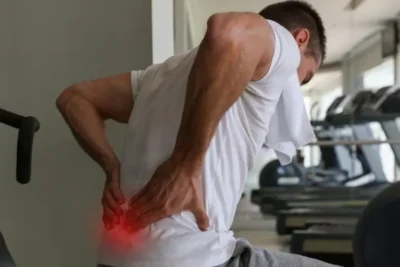
I see so many people dealing with low back, knee, and shoulder pain. One of the ways we combat that pain is by making sure we aren’t using too much weight when we workout those areas. Granted, now and again we might push It a bit on certain things, but for the most part we don’t want too much load ripping apart those areas.
Think of the example from #2 – you are bound to use less load on the single arm exercise we went through just due to the fact of how many things you are forced to focus on. You have more components added to the exercise equalling less load being able to be used.
Think of yourself dealing with some back pain. What do you think would feel better on your back:
- A deadlift with 200 pounds on the bar
- A split squat with 35-40lb DBs in each hand
Not only will you be putting less pressure on your spine in this situation, but you will also be doing both legs which in turn really does feel like doing double the work – which we are going to talk about next!
Reason #4: “More Work”
Now, we don’t have any cited studies that are worth any time here. This is purely personal anecdote from my own training as well as everyone we’ve worked with over the years.
In my eyes if I have someone do 8 reps on each arm for a bench press compared to an 8 rep set of barbell bench press, they just did 16 reps in a set vs. 8.
Yes, they used less with on the single arm bench press.
But say this person gives an 8 out of 10 effort on both arms – they pushed themselves to that level TWICE in one set compared to just ONCE with the barbell press.
Their heart rate will have sustained a higher rate for longer periods of time AND they will have moved their body twice as much.
So, in theory, this type of work could be a great addition for someone looking to stay strong and fit while being able to focus on dropping down some bodyfat in the process.
It’s something I like to use for people to keep their work capacity increasing over time. If we pair a single arm overhead press with a split squat, there won’t be a major amount of rest needed between exercises. The arms will be resting while the legs work (and vice versa) and because it’s one side at a time, those “rests” are elongated each set.
All of this is not to be said against exercises that use two arms or two legs – It is here to show why single arm/single leg exercises deserve a strong showing in your workout plans.
So let’s stop skipping our single arm and single leg work. When I walk into a commercial gym it’s a rare sight to see more split squats than back squats. Or single arm bench presses than barbell bench presses.
With your next workouts try adding a few new exercises into your training and see if you can find some imbalances, added focus to your form, saving of the joints, or even feeling as if you did a little more work.
If you are looking for some exercise ideas or some help figuring out where they might fit in your plan – just shoot us an email at Jeff@NagleFitness.com and we will help the best we can.
In good health,
Jeff