Time constraints, efficiency, consistency, crowds, alone time? If you’ve thought about why you want to workout at home, there has been one main thing driving that idea the most.
Knowing my wife and I were about ready to have our first child, the time commitment of driving to and from the gym would be a bit much with a newborn. This is when I started piecing together our home gym. The idea of being able to walk 20 feet to our garage made it realistic in my head to stick to my routine even with a tiny crazy person moving into our house (he’s the best, my favorite gym buddy).
Whatever the reasons, you want to make the switch to home workouts. Let’s do it!
Your Space
A big piece of your home workout transition is going to be figuring out where in your home you will be working out. Whether you are clearing out the spare bedroom, sharing the living room, or kicking the cars out of the garage, you need your space ready to go.
Now, if you have gotten this far you probably have an idea or two where it will work best for your set-up. Working out in your actual home does have its benefits such as heat/air conditioning as well as being able to utilize everything in your home as extra equipment.
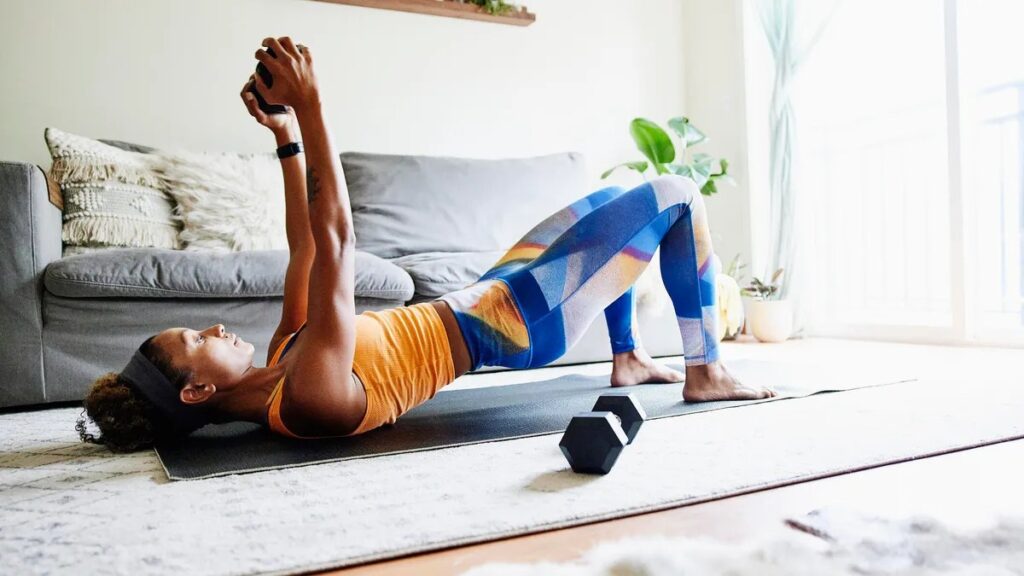
The online clients I work with who workout in their house use EVERYTHING to their advantage. We use their couches, chairs, stools, even coffee tables. There is a use somewhere along the way for everything in your house.
Some of you might have a basement or even garage space to dedicate to some equipment. That is awesome, and gives you some more options because that equipment can stay there permanently. Unlike having a squat rack in the middle of your living room.
What You “Need”
Absolutely nothing. Starting out (depending on your fitness level) you really don’t “need” anything, just some open space.
And I am talking about the lowest level of “need”. If you are in a spot where you have no extra money to shovel towards equipment and can only find the time to workout at home, you can create a bodyweight plan that still benefits you.
Now, obviously more equipment gives you the opportunity to add in more variety and would be ideal, but not everyone has the opportunity to make every single thing in this world “ideal”. Ideally my gym would be the size of a football stadium and jam packed with every piece of equipment I could imagine. As far as I know, that isn’t going to happen.
Here is a sample workout you could do with no equipment:
1a. Air squats 4-5 x 15-25
2a. Push-ups 4-5 x MAX (kneeling or regular)
3a. Alternating Reverse Lunges 3-4 x 12-15ea
3b. Prone Overhead Press 3-4 x 15-20
Your rest between each set will be Prone T Raises x15 reps
These types of workouts are perfect for someone who has no equipment. They can still be scaled and improved upon, they just take a bit more creativity and planning.
The Basics
Trying to figure out exactly what you should have for equipment is hard and really boils down to the individual.
- How much space you have
- How much money you want to spend
- What your goals are
The people that I work with the most are not looking to spend thousands of dollars on gym equipment and aren’t looking to overtake their entire house as a workout space. With that there are still a few things I think every home gym needs.
- Adjustable Dumbbells
Dumbbells are going to be #1 for everyone. Some pairs go up to 24 lbs per hand while others can get up to 120 lbs per hand. For dumbbells, the adjustable style will be the most cost effective and take up the least amount of space.
The amount of variety you can add by just having dumbbells is astronomical, so go get yourself a pair! Here are two different brands I like
Power Blocks – This pair goes up to 50 lbs per hand and is $390.00 new. I love these because they also have expansion packs you can buy that can build them up to 90 lbs per hand. Now, most of us don’t need that much weight, but having the option to add more weight to your existing dumbbells is a great option to have.
They do have a small pair that goes up to 24 lbs per hand and go for $199 new. But they do not have the option of adding any expansion weights.
Bowflex – These go up to 52.5 per hand and are $430.00 new. These are the most universal and are by far the easiest to use. I do not think there is any way to expand these for more weight.
For dumbbells (and just about everything we will discuss), you can always buy these things used on Facebook marketplace. I bought my power block dumbbells off there and It saved me about $500 all together.
- Resistance Bands
These might not be as important as dumbbells but they still have their place. First off, they take up barely any space at all. So no matter where you workout, bands can fit their way in.
Second, they are relatively inexpensive when It comes to fitness equipment. They are a great way to add some more variety to your training, especially when It comes to rowing type exercises (things for the backside of your upper body).
You can get bands with handles on them but I find the ones with a loop last much longer. Perform Better makes some good bands. To start I would get one of each of these bands:
- Suspension Trainer
A suspension trainer like a TRX strap is a huge addition to your home gym, as long as you have a place for It. They can get anchored to a wall or be paired with a door stopper to lock into a doorway.
This is another piece of relatively cheap gym equipment that gives you so much more variety in your training, highly recommend!
TRX is just a brand of suspension trainer and will cost you anywhere from $120-$220. You can find other brands on amazon or even at stores like Aldi that will cost closer to the $30-$50 range. They all do relatively the same thing.
What Else Can I Get?
The above three pieces of equipment are your first priority. You can do a lot with those three things and reach just about any goal you are working towards. Now there are a few other things you can get if you have the space and the money for It.
- Adjustable Bench
These will run you anywhere from $100-$300 depending on how fancy you want to get. You really don’t need anything crazy, just a bench that lets you lay on It without collapsing. This will take up more space and be more of a pain in the ass to move around than the other things we listed before, so be aware of that!
- Squat Rack
- Barbell w/ weights
These two go together and are somewhat irrelevant without each other. These two pieces can be great as long as you have the space for them. IIf you are a beginner or recently started training, you really don’t need either of these. That doesn’t mean you can’t find use for them, but the dumbbells, bands, and suspension trainer will be just fine for A WHILE.
In all honesty, with these 6 pieces of equipment you can do just about everything you could possibly want when It comes to exercise. Now, just looking at them, they are just random pieces of workout crap, but right now I am going to go into a template to follow for your home workouts!
Workouts
I guess the equipment is not as important as what you actually do with that equipment. Home workout people, like myself, seem to love efficiency. That is why we are going to go over a full body workout template for 1-3 days per week.
These workouts are going to be efficient and effective giving you the ability to get quality workouts done at home!
What I am asking of you:
- 1-3 workouts per week
- 45-60 minutes
- Don’t skip your warm-up
- Work HARD
- Have some fun
Warm-up: I did a full article on warm-ups. Read It HERE for more detail on what you should do. A quick outline will be below, but if you want specifics go read It!
- Roll/Pressure
- Stretch
- Mobilize
- Activate
This WILL get you better prepared for a workout. Especially if you are working out literally minutes after waking up from a nap on your couch.
Day 1: Full Body
1a. Squat variation
1b. Upper body pull
2a. Leg curl or hinge
2b. Upper body push
3a. Core
3b. Upper back
Day 2: Full Body
1a. Bench press variation
1b. Hinge variation
2a. Upper body pull
2b. Squat or single leg squat
3a. Core
3b. Arms
Day 3: Full Body
1a. Hinge variation
1b. Upper body push
2a. Single leg squat variation
2b. Upper body pull
3a. Core
3b. Upper back
Here are some examples of each type of exercise:
Squat variation: Goblet squat, DB rack squat, sumo squat, heels elevated squat
Upper body pull: Single arm row, bent over row, chainsaw row, plank row, elevated plank row
Leg curl: banded leg curl, sliding leg curl (using towels or socks on hardwood floors), DB leg curl
Hinge variation: Romanian deadlift, single leg RDL, b-stance RDL, sumo RDL, suitcase deadlift, hip thrust, single leg hip thrust
Upper body push: Floor press, push-up, seated DB press, single arm floor press, DB z-press
Core: Plank drag, forearm plank, hollow hold, side plank, leg lowering, plank tap
Upper back: Band pull apart, prone t-raise, ISO hold Y-W-T, bent over reverse fly, band face pull, banded reverse fly
Arms: bicep curl, overhead tricep extension, hammer curl, bench dip, banded bicep curl, skullcrusher
This obviously isn’t every exercise under the sun for each category but gives you a general idea what exercises fall into what group.
You don’t need the most amount of space in the world and you definitely don’t need a bunch of crazy equipment. Start small and build on what you have over time. For now, if you want to workout at home, grab a set of dumbbells and start following these workout templates!
In good health,
Jeff