How To PROPERLY Assess Clients
Trying to get clients was hard enough as a new trainer but I soon realized that after I attracted a potential client I had to ASSESS THEM. This was all stuff I was not fully prepared for.
We
would take the clients into the enclosed “sales” room and talk about lifestyle,
habits, injuries, etc. but I wasn’t even able to listen because all I could
think about is physical portion of the assessment.
Almost
disregarding all of the information I was just given I would take the clients
onto the floor and bring them through the FMS assessment. Squat, step over
this, lunge down over here, do a pushup; as I did more and more of these things
I got more comfortable doing them making my scoring more critical.
I began to realize that a very high percentage of people were unable to perform more than half of these moves without pain or with any good form at all.
Without
a proper way of figuring out what the client needs other than what was
discussed in the consultation, I would have to work twice as hard to assess
someone as we move forward.
This
seemed ass-backwards to me.
Moving
forward I was fortunate enough to work with people who had a lot of knowledge,
experience, and passion in this field.
The
first thing we did was shut down my old way of assessing.
NEW FOCUS
The
first thing we looked deeper into was the actual consultation portion of the
assessment.
That
was my NEW FOCUS.
I knew
that building strong relations was beneficial but we began to look how much
information a new client is willing to share with you off the bat.
We
called it the assessment before the assessment (not a consultation). I had to
focus on listening 2x more than I talked as a general rule of thumb, which I
learned from a podcast called Mind Pump (if you haven’t listened or watched
these guys I recommend them BIG TIME).
Listen
more, it sounded so easy but I gave it a try and I can’t express enough how
much of a positive response I received.
Before
heading to any physical assessment I felt as if I knew almost everything about
these people.
Goals,
what makes them happy, pain over the years; you name it, I was able to get
everything out of my clients.
THE PHYSICAL ASSESSMENT
The
physical portion is where I lacked the most knowledge because for everyday
people the FMS assessment is not the best option.
I moved
to an assessment that had two portions, Passive
and Active. I got this format from a
gym I worked at when moving to New York. Very intelligent people involved with
that place with a shit load of knowledge.
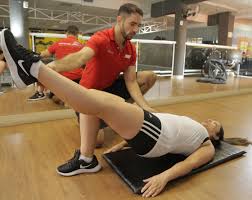
The PASSIVE portion would involve myself
taking a person through certain ranges of motion to find what work must be done
in their programming to make things move better.
PASSIVE ASSESSMENT
- Shoulder Flexion/Extension
- Shoulder Internal/External Rotation
- Thoracic Spine Rotations (side lying)
- Hip Flexion/Extension
- Hip Internal/External Rotation
- Active Straight Leg Raises
- Floor Slides
Taking
notes of everything was imperative to make sure I had enough information to
evaluate afterwards. Also it was key to accurately read how far a joint was
able to move in comparison to the opposing side.
When
moving the joints of another person you will feel a strong resistance from them
at a certain point, this is known as R1.
The
joint is generally able to move beyond this point but make sure to communicate
with the client that you are going to do so SLOWLY.
The ACTIVE portion looked at how the body
reacted to certain movements, mainly looking at the stability of the joints. I
will go into more detail about these movements once they are listed
ACTIVE ASSESSMENT
- Squat
- Pushup
- Seated T-Spine Rotations
- Ankle Flexion
- Wall Slides
For
these movements I already have a general idea of how their body SHOULD be able to move but, due to
muscle disconnect, muscle weakness, bad movement patterns, poor stability, (the
list could go on) most of these movements are not easy for the everyday person.
Which is why I have certain things I look for in each movement and focus on how
the body works as a unit throughout the movement.
Each
and every movement has their own areas of focus for a trainer and are not always
obvious things causing issues. This is why we cannot assume that pain,
weakness, or poor movement is caused by one single thing.
Many
times it is caused by multiple things and usually is never as easy as what is
on the surface.
These assessments take practice to so find someone you know and begin practicing on them. Fine-tune your skills and start getting people moving functionally.
JNHealthandFitness@aol.com